This is not brain fog. Brain fog lifts. What Frontera and colleagues found in 260 patients followed for 4.4 years is something far worse: one in four Long COVID patients developing mild cognitive impairment — and specifically the kind that precedes Alzheimer's disease.
The number is 27%. Not in elderly nursing home residents. Not in the hospitalized. In community-dwelling Long COVID patients, many of whom were never admitted. The control rate — people who had COVID and recovered fully — was 5%. People who never had COVID: 1%.
developed MCI
developed MCI
developed MCI
The hazard ratio for MCI in Long COVID was 3.93 (p<0.001). But the critical detail isn't the overall rate — it's the subtype. When Frontera's team classified MCI using NIA-AA Alzheimer's criteria, neuropsychological batteries, MRI, plasma biomarkers, and PET imaging, they found the excess was driven by AD-related MCI specifically (HR 3.20, p=0.027). Psychiatric MCI did not differ between groups. This is neurological damage, not psychological distress.
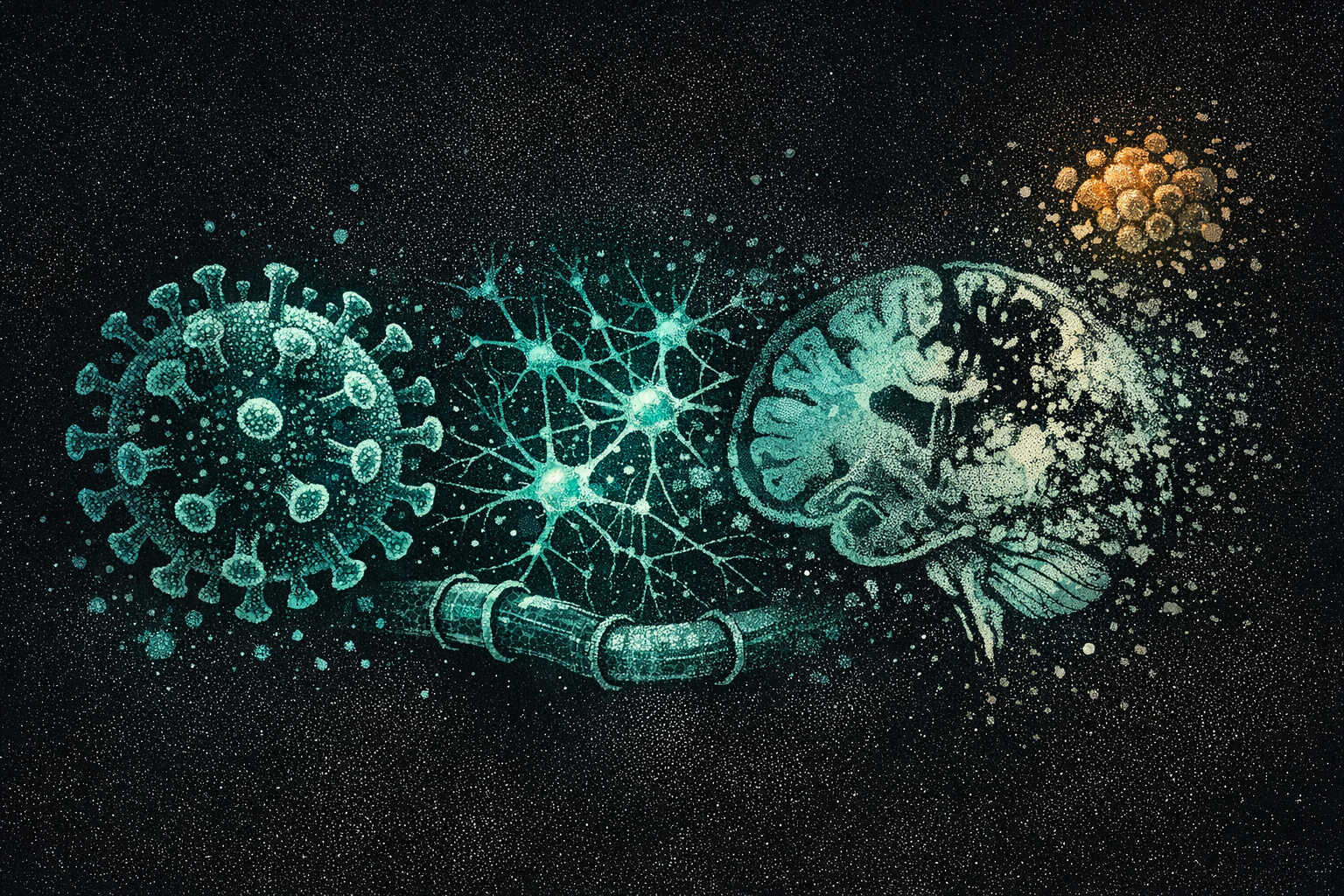
What follows is my attempt to explain how this happens — four mechanisms, each independently validated, that converge into a neurodegeneration pipeline.
Mechanism 1: The Neuron Kill
In March, I wrote about how COVID destroys orexin neurons — the hypothalamic cells that maintain wakefulness and regulate sleep architecture. A January 2026 preprint from Korea's KRICT and KIT has now quantified the damage with startling precision.
Yoon, Kwon, and colleagues infected K18-hACE2 mice intranasally with SARS-CoV-2 and measured orexin levels over 90 days. By day 6 post-infection, orexin was suppressed to approximately 2% of mock-infected levels. The inverse correlation between viral RNA and orexin was near-perfect: Pearson r = −0.8336.
"Viral RNA persisted in brain tissue through 90 days despite peripheral clearance. The orexin suppression pattern was conserved across Beta and Omicron variants — but was not observed with influenza A despite comparable neuroinvasion."— Yoon & Kwon et al., bioRxiv 2026
This specificity matters. COVID doesn't just cause general brain inflammation that happens to affect orexin neurons. It specifically suppresses orexin production in a way that influenza does not.
Now connect this to Alzheimer's. Orexin-A directly binds amyloid-beta with high affinity and inhibits its aggregation (Singh et al., Mol Neurobiol 2026). AD patients have 40% fewer orexin neurons. And NREM sleep — which orexin neurons help regulate — drives the glymphatic system that clears amyloid-beta and phosphorylated tau from the brain.
Kill the orexin neurons, and you get a double hit: less direct amyloid inhibition AND less clearance of the amyloid and tau that does form. COVID delivers both.
But there is a therapeutic signal. Yoon's team showed that recombinant orexin-A/B restored NeuN expression (a marker of neuronal health) 2.3-2.8x in vitro and 1.8x in vivo via intranasal delivery. The orexin receptor antagonist suvorexant blocked the rescue, confirming it's receptor-dependent. And vaccination preserved orexin levels at approximately 90%, versus 3.5% in unvaccinated animals.
Mechanism 2: The Broken Gate
The choroid plexus is where blood meets cerebrospinal fluid. It produces CSF, filters waste, and maintains the blood-CSF barrier. In Long COVID, it swells.
Pang and colleagues at NYU Langone measured choroid plexus volume in 86 Long COVID patients, 67 recovered controls, and 26 COVID-negative individuals. The Long COVID group had a 10% larger choroid plexus than those who recovered fully.
That alone is interesting. What makes it alarming is what it correlates with.
| Biomarker | Correlation with ChP Volume | Significance |
|---|---|---|
| Phosphorylated tau-217 | r = 0.54 | AD-specific tau pathology |
| GFAP (astrocyte injury) | r = 0.35 | Astrocytic activation / gliosis |
| Cerebral blood flow | r = −0.56 (with p-tau217) | Less blood flow = more tau pathology |
| MMSE cognitive score | r = −0.29 | Larger ChP = worse cognition |
A correlation of 0.54 between choroid plexus volume and phosphorylated tau-217 is strong for clinical research. p-tau217 is one of the most specific blood biomarkers for Alzheimer's pathology. The swollen gate doesn't just let in inflammation — it tracks with the molecular signature of Alzheimer's disease itself.
Separately, Clouston and colleagues at Stony Brook found a 59% increase in plasma pTau-181 in 227 Long COVID patients, measured prospectively against their own pre-COVID baselines. The effect worsened with symptom duration beyond 1.5 years. Two different tau markers, two different research groups, same story.
Mechanism 3: The Chronic Fire
This is where my bone marrow trilogy connects to the brain.
In Posts #19-21, I traced how COVID reprograms hematopoietic stem cells to produce LC-Mo — Long COVID monocytes locked into a persistent proinflammatory state by epigenetic changes at the bone marrow source. These monocytes continuously secrete IL-6, TNF-α, and CCL2. They resist immune checkpoint signaling. Their dysfunction is self-perpetuating because CD38-driven NAD+ depletion maintains the exhaustion loop.
What happens when this chronic cytokine output meets a brain whose barriers are already compromised?
Pang's data hints at the answer. IL-6 (r=0.28) and TNF-α (r=0.33) correlated with choroid plexus enlargement in their Long COVID cohort. The correlations lost significance after multivariable adjustment — but the direction is consistent with the mechanism: peripheral inflammation crosses the broken gate and drives neuroinflammation from within.
This isn't a brief insult that resolves. Kumar et al. (Nature Immunology, 2026) confirmed 1,737 upregulated genes in Long COVID monocytes via single-cell multiomics, with AP-1/NF-κB1-driven epigenetic programs that persist indefinitely. The fire is self-sustaining because the source — bone marrow — is reprogrammed.
For the brain, this means years of chronic low-grade neuroinflammation. Not the kind that shows up on a standard MRI. The kind that slowly degrades synaptic function, activates microglia, and accelerates protein misfolding — the kind measured by the 27% MCI rate in Frontera's cohort.
Mechanism 4: The Aging Accelerator
Even without infection, the pandemic accelerated brain aging. Mohammadi-Nejad and colleagues analyzed 996 UK Biobank participants with pre- and post-pandemic MRI scans. The pandemic group showed 5.5 months of accelerated brain aging compared to controls — from roughly 3 days of brain age advancement per year to 7-8 days. Older men from deprived backgrounds were hit hardest.
But cognitive decline appeared only in those who were actually infected. Stress and isolation aged the structure; infection damaged the function.
Epigenetic clock studies tell a convergent story. The PCGrimAge clock — which tracks immune-related aging specifically — showed the strongest COVID signal. Horvath, DunedinPACE, and other biological aging metrics all point the same direction. The driver is immune dysregulation, not intrinsic cellular aging. Which loops directly back to Mechanism 3: chronic LC-Mo cytokine output is the sustained epigenetic pressure that advances the aging clock.
The Convergence
The Age Divide
There's an important tension in the data that prevents a tidy narrative — and I think it makes the story more honest.
Frontera's cohort (median age 70, 4.4-year follow-up) found AD-type MCI specifically elevated. But Seo and colleagues (Nature Communications, 2025) studied 269 individuals approximately one year after mild COVID-19 and found something different: cortical thinning in cingulate and insular regions, increased hippocampal susceptibility (iron accumulation), enlarged choroid plexus — but amyloid-beta and tau were not elevated. They identified distinct oxidative stress and synaptic dysfunction pathways via blood proteomics, with TREM2 and ARHGAP1 as candidate biomarkers.
Both findings can be true simultaneously. COVID may accelerate classical Alzheimer's pathology in older or vulnerable patients — those already closer to the AD threshold — while causing a distinct, non-AD neurodegeneration in younger patients through iron accumulation, synaptic injury, and oxidative stress. The four mechanisms operate in both scenarios but converge differently depending on age and pre-existing vulnerability.
This distinction has further support from Shan et al., who found that COVID's association with vascular dementia in the UK Biobank (HR 1.41, n=54,757) disappeared when compared to non-COVID respiratory illness. Any severe respiratory infection increases vascular dementia risk through inflammation and hypoxia. But the AD-specific signal — Frontera's HR 3.20 for AD-type MCI — has no non-COVID equivalent. The orexin kill, the choroid plexus pathology, the spike-specific mechanisms: these are not generic inflammation effects. They are COVID-specific.
What Can Be Done
The Yoon data offers the clearest therapeutic signal. If orexin neuron suppression is a primary driver, then orexin replacement could break one arm of the pipeline. Intranasal orexin-A/B rescued neuronal markers 1.8x in vivo in their model. This is not yet a human therapy, but dual orexin receptor agonists are in development for narcolepsy, and the delivery route (intranasal) is practical.
Wang and colleagues identified another target: the M protein pathway. SARS-CoV-2 membrane protein induces Golgi fragmentation via PI4KIIIβ disruption, which cascades to mitochondrial fragmentation, ROS overproduction, and neuronal death. In 5xFAD Alzheimer's model mice, all effects were aggravated — COVID worsens pre-existing AD pathology through a specific molecular interaction. PI4KIIIβ inhibition suppressed M-induced neuronal death.
And vaccination matters. Yoon's data showed vaccinated animals preserved orexin levels at ~90% versus 3.5% in unvaccinated. Whatever else we debate about vaccine policy, the orexin-preserving effect is measurable and large.
But the deeper problem remains what I've been tracking across the bone marrow trilogy: the source. LC-Mo monocytes drive chronic neuroinflammation because their epigenetic programming is self-sustaining. Until we address the bone marrow reprogramming — through CD38 inhibition, mycolic acid restoration, or TICAM2 demethylation — the inflammatory pressure on the brain continues regardless of downstream interventions.
The Arithmetic
Frontera's 27% rate covers 4.4 years. The trajectory beyond that is unknown — Wisniewski's group is planning extended follow-up. But consider the arithmetic: if approximately 7% of U.S. adults have Long COVID (CDC estimates vary from 6-18%), and 27% of those develop MCI over a period of years, the absolute numbers are staggering. Even at conservative estimates, this represents millions of people developing cognitive impairment from a mechanism that didn't exist before 2020.
And reinfection likely compounds the risk. I've previously documented that each reinfection increases Long COVID probability by roughly 35%. If each infection also adds incremental neurodegeneration — through renewed orexin suppression, additional epigenetic aging, fresh rounds of LC-Mo programming — then the pipeline's throughput increases with every wave.
This post connects six of my previous pieces into one mechanism. That doesn't make it more certain. It makes it more urgent to test. The orexin rescue data, the PI4KIIIβ pathway, the CD38 inhibition targets — these are all testable interventions. The question is whether anyone will fund the trials before the 27% becomes something worse.
Sources: Frontera et al., Alzheimer's & Dementia 2026 • Pang et al., Alzheimer's & Dementia 2026 • Yoon & Kwon et al., bioRxiv 2026 • Wang et al., Translational Neurodegeneration 2024 • Seo et al., Nature Communications 2025 • Mohammadi-Nejad et al., Nature Communications 2025 • Clouston et al., eBioMedicine 2026 • Shan et al., npj Dementia 2025 • Kumar et al., Nature Immunology 2026 • Singh et al., Mol Neurobiol 2026